
Before the Rum Rebellion, the River Rose
Before the Rum Rebellion reached its breaking point, the Hawkesbury floods had already reshaped early colonial life. Drawing on Sydney Gazette reports and the devastating floods of 1801, 1806, and 1809, this piece examines environmental loss, food insecurity, and a landscape that resisted control. It situates William Cox’s Hawkesbury and Parramatta landholdings — including Windsor, Clarendon, and Brush Farm — within a colony under constant pressure from water, scarcity, and instability.
UNBOUND SERIESAT THE TABLE — WITH THE COCKTAIL DIARIESHISTORIC HEARTBEATS
Dianna Ishtar
1/24/20263 min read
Long before the Rum Rebellion reached its breaking point, the Hawkesbury had already delivered its verdict.
In March 1806, after weeks of relentless rain, the river rose with little warning. By the 29th of March, vast stretches of the Hawkesbury-Nepean plain were submerged. Contemporary accounts described a landscape where rooftops disappeared beneath the waterline, people and livestock clung to trees, and entire settlements were temporarily erased.
This wasn’t an inconvenience.
It was devastation.
The Scale of the Loss
Early reports published in the Sydney Gazette speak in the language of horror and disbelief. An estimated 36,000 acres were inundated. Hundreds of people required rescue. Crops were lost. Livelihoods undone.
The economic impact was immediate and severe — losses were estimated at over £30,000, an extraordinary sum for a young colony already operating on the edge of scarcity.
Governor King responded by restricting bread consumption in Sydney, banning cakes and pastries to conserve supplies.
Even celebration was rationed.
Flooding Was Not an Anomaly — It Was a Pattern
The Hawkesbury floods of 1801, 1806, and 1809 were not isolated events. Together, they formed a brutal education for early settlers: the land they were trying to control did not submit easily.
These floods reshaped the colonial economy, disrupted supply lines, and exposed just how fragile governance and food security really were.
Long before soldiers marched on Government House in 1808, the colony had already learned what it felt like to lose control.
Windsor, Cox, and the Land That Would Not Sit Still
By this period, William Cox held extensive landholdings in the Hawkesbury & Parramatta regions — including areas around Windsor, Clarendon, and Brush Farm.
Historical records confirm that Cox developed his estates as self-contained working communities, with skilled trades, mills, and agricultural operations functioning under his oversight. These lands were productive — but they were also vulnerable.
While precise flood heights for each property vary across records, what is clear is this:
no one operating along the Hawkesbury was untouched by flooding.
The river did not respect boundaries, titles, or ambition.
It tested everything.
Scarcity Breeds Tension
When we talk about the Rum Rebellion, it’s tempting to frame it purely as a power struggle — military versus governor, trade versus regulation.
But beneath that conflict sat something more elemental:
food insecurity
disrupted supply
exhausted labour
land that refused to behave
Rebellion does not emerge in comfort.
It emerges when systems already under strain finally fail.
Why This Still Matters
Later floods — particularly the catastrophic events of 1867 — would eclipse 1806 in sheer scale. But the 1806 flood stands as a benchmark moment, an early warning written into the landscape itself.
The Hawkesbury taught the colony a lesson early:
You can claim land.
You can govern people.
But you do not command the river.
At the Table
If there’s a food that belongs beside this history, it isn’t celebratory.
It’s practical. Sustaining. Built to last.
Something you could hold while watching the water rise — knowing that survival, not spectacle, is the priority.
This table is built for endurance.
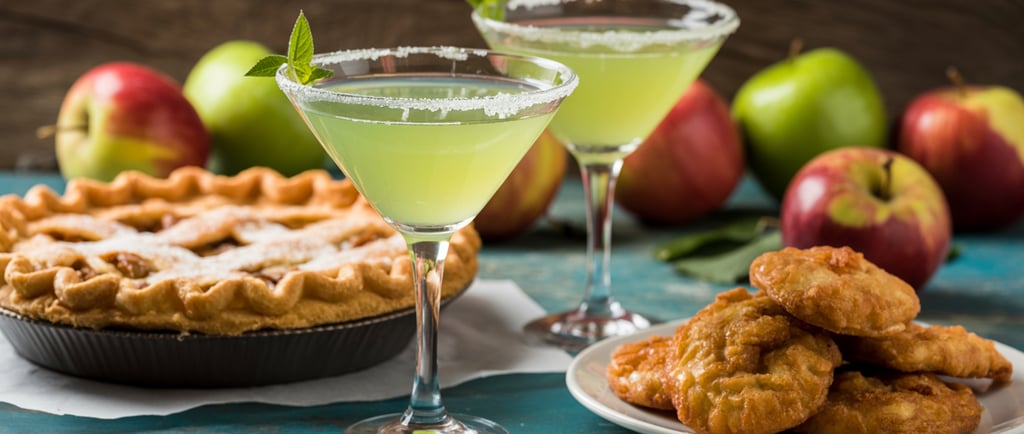
Apples cooked simply — folded into pastry with spices like a deep dish dutch apple pie or fried into a fritter like the popular 1830’s treats — food that waits, then feeds. Apples store. Apples ferment. Apples carry people through when fresh supply fails and certainty disappears.
Alongside it, Sam’s Garden Appletini (page 142) in The Cocktail Diaries — restrained, dry, and unapologetic. Apple here is not sweetness. It’s patience. A reminder that survival often tastes quieter than celebration.
This is a table set after loss — when what matters is what lasts.
When it might just be you, or unexpected guests.
Not spectacle.
Continuity.
Before rebellion came flood.
Before fracture came loss.
And before history hardened into dates and monuments, there were people standing in trees, waiting to be rescued — learning, very quickly, that nothing in this place was guaranteed.
Inspired
Crafting beauty with intention.
info@diannaishtar.com
© 2025. All rights reserved.