
The Day They Saw the Mountain
On Boxing Day in 1814, they broke through to the plains. After weeks of cutting, climbing, and persistence, they reached a point where the land opened and something long known — but not yet recorded — came fully into view. Cox wrote of “the mountain”. I think often about first seeing just a year after Blaxland, Lawson, and Wentworth. About how presence precedes understanding. About how something can exist in full truth long before it enters language or history.
AT THE TABLE — WITH THE COCKTAIL DIARIES
Dianna Ishtar
12/26/20252 min read
The Day They Saw the Mountain
In 1813, three British explorers — Blaxland, Lawson, and Wentworth broke through to the plains and witnessed what they would later call “the mountain.”
It was not the first time human eyes had rested on that horizon. For tens of thousands of years, Aboriginal people had known those ridgelines intimately — as pathways, stories, and law. But this was the first time it was written down through colonial eyes.
A moment of seeing.
Before naming.
Before consequence.
The mountain itself did not change that day.
Only the witnessing did.
That distinction matters to me.
Before the Road
A year later, on Boxing Day 1814, William Cox would be tasked with turning that moment of sight into something solid — a road across the Blue Mountains.
Cox kept an exact journal of that work, not as a literary exercise, but as a record of labour and direction. On Christmas Day during the road-making, he wrote that he issued each man a gill of spirits and a new shirt — a small grace amid havoc and toil. The diaries mention this detail matter-of-factly, almost as though it were simply another task checked off the list.
No grand speech.
No ceremony.
Just sustenance, acknowledgement, and a small easing of the body after labour.
That detail has stayed with me.
History is often taught as momentum — dates, achievements, outcomes — but diaries remind us that it was lived in skin and muscle. In thirst. In cold. In the relief of clean cloth and a measured drink.
A Drink for the Threshold
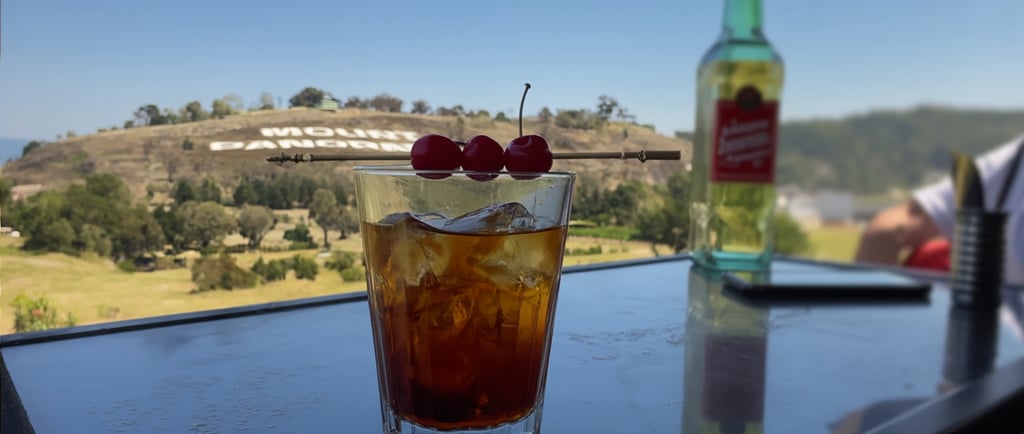
So tonight, to mark this beginning — this seeing before naming — I reach not for rum, but for something layered and intentional.
Sam’s Sazernach
(The Cocktail Diaries, page 14)
It begins with a Scottish whisky — warm, grounded, carrying history in its grain. There’s a trace of cherry sweetness, a dark thread of spice, and just enough bitterness to keep it honest.
And — the absinthe.
Not poured.
Not dominant.
Just a mist.
Enough that the nose catches it first — that old green whisper beloved of poets and intellectuals — before the palate settles into something altogether smoother, sweeter, more restrained. You’re left with spice and warmth rather than the full force of the fairy.
It’s a drink that understands restraint.
A drink that knows when not to speak loudly.
(And yes — I adore the diary styling of the book, though I may need to strategically cover some of Sam’s more distracting images if I’m to concentrate properly on the written content.)
Standing at the Edge
On that Boxing Day, no one standing there could yet imagine the road, the settlements, the costs, or the lives that would be altered because of what followed.
They simply stood at the edge of something newly acknowledged.
That is the place I return to in this first Unbound Series post — the pause before action, the breath before decision, the moment where curiosity hasn’t yet hardened into claim.
The mountain did not change.
But everything that followed depended on how it was seen.
Tonight, I raise a glass — not in celebration of conquest, but in recognition of thresholds. Of history lived by bodies. Of moments that seem small until time reveals their weight.
Some things deserve to be approached slowly.
With attention.
And with care.
Inspired
Crafting beauty with intention.
info@diannaishtar.com
© 2025. All rights reserved.